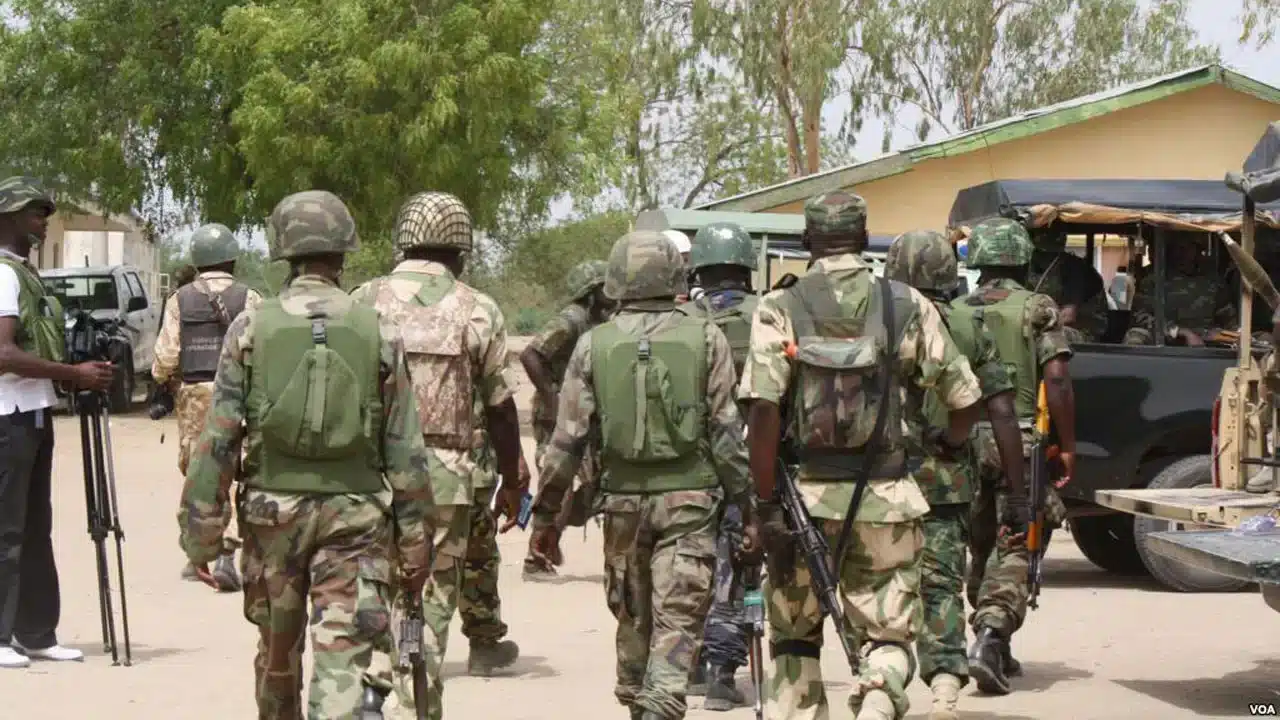
Turkiye is planning to establish defence production facilities and military training centres in Nigeria as both countries move to strengthen security cooperation and increase bilateral trade to $5 billion.
Turkish Ambassador to Nigeria, Mehmet Poroy, disclosed this on Monday in Abuja during a press briefing to mark 66 years of diplomatic relations between the two countries.
Poroy said the proposed facilities would enable Turkiye to support local production of weapons and other military equipment rather than relying solely on supplying finished products to Nigeria.
He explained that the initiative formed part of efforts to implement agreements reached during President Bola Tinubu’s visit to Turkiye earlier this year, which involved nine Nigerian ministers and produced nine agreements and memoranda of understanding.
“We are planning to have some local production unit also in that context, not only selling to Nigeria the tools, equipment, and arms that it needs, but also the possibility of having local production here in Nigeria,” he said.
On military training, Poroy disclosed that 200 Nigerian special forces personnel were completing a two-month training programme in Turkiye, while discussions were ongoing to establish a similar facility in Nigeria.
He said the proposed centre would allow Turkish military officers to provide continuous training for Nigerian soldiers without requiring all personnel to travel abroad.
“Not all the military personnel will be carried to Turkey, but in the presence of some Turkish officers to train them, we will have a continuous training activity for the Nigerian Army,” he said.
The ambassador also offered to share Turkiye’s experience in tackling terrorism, noting that his country had lost more than 40,000 people and spent billions of dollars in its 40-year fight against the menace.
He stressed that addressing terrorism required more than military operations, as economic and religious factors also played significant roles.
Poroy identified defence as a major area of cooperation, noting that the Nigerian military already used Turkish attack helicopters and drones in operations against insecurity, particularly in northern Nigeria.
On economic relations, he said both countries were targeting $5 billion in bilateral trade, up from the current $2 billion, including oil and gas.
He described the existing trade volume as relatively small compared with Nigeria’s economic potential and said more Turkish investments were needed.
According to him, Turkish investments across Africa exceed $10 billion, while investments in Nigeria remain below $1 billion.
Poroy said he visited the Abuja Chamber of Commerce and Industry on Monday alongside the Turkish Commercial Counsellor to explore opportunities for increased trade and investment.
He added that the embassy had held similar engagements with chambers of commerce in Kano, Kaduna and Lagos, while facilitating visa procedures for Nigerian businesspeople to encourage direct commercial partnerships.
On humanitarian assistance, the envoy said the Turkish Government had provided food support to 3,000 internally displaced families in Adamawa State.
He added that Turkish non-governmental organisations, including the Turkish Religious Affairs Foundation, spent about $5m on humanitarian interventions in Nigeria over the previous year, mainly through food donations and meat distribution during Ramadan and Eid-el-Adha.
Poroy said Turkiye would continue supporting humanitarian programmes in Nigeria and was considering a more structured arrangement with the Nigerian authorities.
He also traced relations between both countries to the 16th century, when the Ottoman Empire maintained correspondence with the Kanem-Borno Sultanate.
Formal diplomatic relations at ambassadorial level began on November 9, 1960, following Nigeria’s independence on October 1 of the same year. Turkiye had earlier opened a Consulate-General in Lagos on April 19, 1959.
Poroy described Nigeria as a strategic partner because of its importance to security, stability and economic development in West Africa and the wider African continent.
He also called for stronger cultural relations, announcing that an art exhibition titled In Nature, featuring works by his wife, would open at the Ministry of Foreign Affairs’ Atrium Art Gallery on November 20.