
 Follow Us On Google
Three Senior Advocates of Nigeria (SANs) have insisted that the law allows Nigerians to film police officers while they are performing their duties in public spaces.
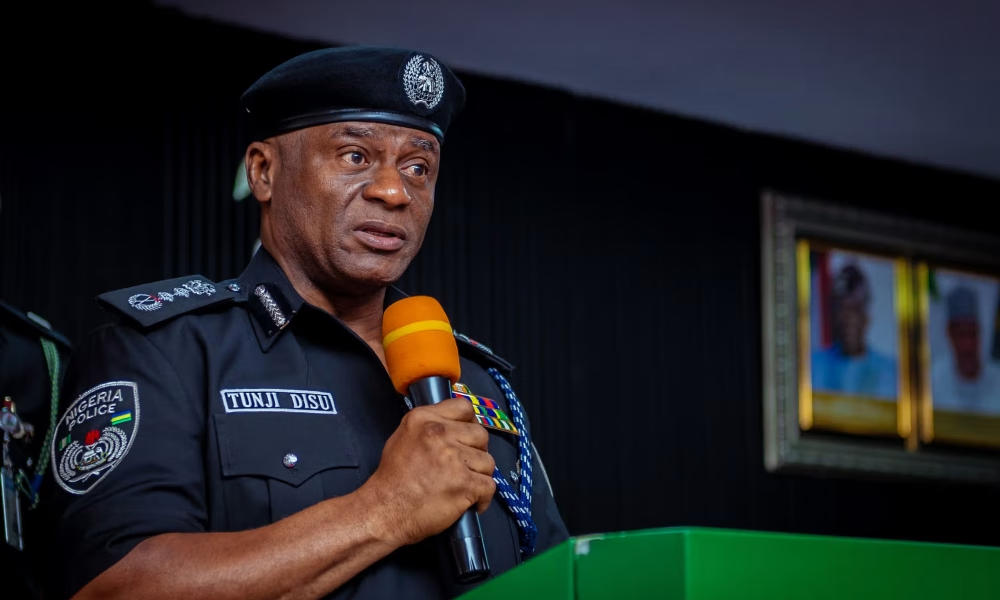
Naija News reports that the lawyers were responding to a recent submission by the Inspector-General of Police, Olatunji Disu, which has raised concerns among Nigerians about the effect of recording police officers on duty.
The lawyers, Olu Daramola, Olalekan Ojo and Isiaka Olagunju, gave different perspectives on the matter, with Daramola relying on an existing Federal High Court judgment, while Ojo and Olagunju highlighted both the benefits and possible dangers of recording police activities.
Disu had recently criticized a court decision encouraging Nigerians to record police officers in different situations, describing the development as “very, very demoralizing” for the police.
But Daramola, in a statement on Friday, September 11, 2026, said the matter had already been settled by the court, pointing to the judgment of Justice Hyeladzira Nganjiwa in the case of Maxwell Uwaifor vs Inspector-General of Police.
He said, “The law as it stands today is that Nigerians have the right to record police officers on duty in public spaces.
“The judgment was handed down by Justice Hyeladzira Nganjiwa of the Federal High Court in Maxwell Uwaifor v IG since March last year. It remains binding and subsisting.”
According to Daramola, the court went beyond recognizing the right of citizens to record police officers.
He said the court also ordered police officers to display visible name tags and force numbers to make it easier for members of the public to identify them.
The SAN added that the judgment prohibited police officers from seizing mobile phones belonging to members of the public or deleting footage recorded by citizens.
Daramola said the court’s position was consistent with Section 39 of the 1999 Constitution, which guarantees freedom of expression as well as the right to receive and impart information.
He argued that the constitutional provision covers the documentation of public officials while carrying out their duties, provided the person making the recording does not interfere with the officer’s lawful duties.
“The judgment cannot be faulted going by Section 39 of the 1999 Constitution, which guarantees freedom of expression and the right to receive and impart information, which covers documenting public officials.
“The only limitation is that you cannot obstruct or prevent a police officer from performing his lawful duties,” he said.
Daramola also noted that recording police activities was not peculiar to Nigeria, pointing out that police officers in several countries use body cameras while carrying out their duties.
He argued that officers who are performing their duties lawfully should have no reason to fear being recorded by members of the public.
“A police officer carrying out his lawful duties in a lawful manner has nothing to fear.
“Therefore, the position of the NBA represents the law. The IG pronouncement cannot override the law, as he and his officers are duty-bound not only to obey the decision of the court but also to ensure that it is enforced to the letter,” Daramola said.
Recordings Can Preserve Evidence – Says Ojo
Ojo also backed the position of the Nigerian Bar Association (NBA) that citizens have the right to record police officers while on duty.
He said allowing members of the public to record police activities could promote transparency, encourage good conduct and preserve evidence that could be useful in cases of alleged misconduct.
However, the SAN warned that citizens should not ignore their personal safety when deciding to record police officers.
According to him, recording police activities should not be viewed only as a transparency issue, as it could also amount to evidence gathering and preservation.
“Recording in Nigeria today, in my view, also constitutes a form of evidence gathering and preservation.
“Indeed, with the greatest respect to the IG, it is through such recordings that some members of the police force, who could have denied any form of wrongdoing, were successfully apprehended and disciplined.
“Without such recordings, such disciplinary action, including apprehension, would have been impossible or difficult,” he said.
Ojo said police officers who know that their activities could be recorded would likely become more careful about their conduct while performing their duties.
He said, “If the police know, as they now know, that their activities may be recorded, then they will be much more careful as to what they do in the course of discharging their duties.
“So, I agree, it makes for transparency. It also enhances good conduct on the part of the police.
“If nobody has anything to hide, if nobody has anything to be afraid of, why should you be afraid of being recorded? If what you are doing is good, it is even good for you. They should record you and let the whole world know that this is a very good police officer.”
Despite supporting the right to record police officers, Ojo said citizens must also consider the circumstances before bringing out their phones.
He said some police officers could react violently after discovering that they were being recorded, especially where they believe the footage could expose them to disciplinary action.
“I have seen cases where police officers, upon discovering that they were being recorded, got angry and decided to do the unthinkable and the unspeakable,” he said.
According to Ojo, a police officer who believes that a recording could cost him his job may try to seize or destroy the phone or even harm the person making the recording.
He said this could be the concern behind the IGP’s position on the matter.
Ojo, however, maintained that citizens should use their judgment and assess the situation before deciding whether to record.
“Perhaps that is the angle from which the IG was looking at it. So, you have to balance it. You have to use your sense. Is it safe to record? If it is safe to record, go ahead and record.
“If it is not safe, you are the only one there. I will advise you not to record, because if you are caught, anything can happen,” Ojo said.
‘IG May Have A Point On Safety’
Olagunju similarly acknowledged that the IGP might have concerns over the privacy and safety of police officers.
He, however, said such concerns should not prevent the public from recording police officers or other public officials when they fail to perform their duties properly.
According to him, recordings made in such situations could help promote accountability and serve as evidence of misconduct.
“The IG may be right to some extent because of privacy and safety of the police officers. However, in some circumstances, recording a police officer or any other public officer who is derelict in his or her duty should also be encouraged,” Olagunju said.





Join the conversation
Comments
Want to discuss? Please read our Commenting Policy first.