
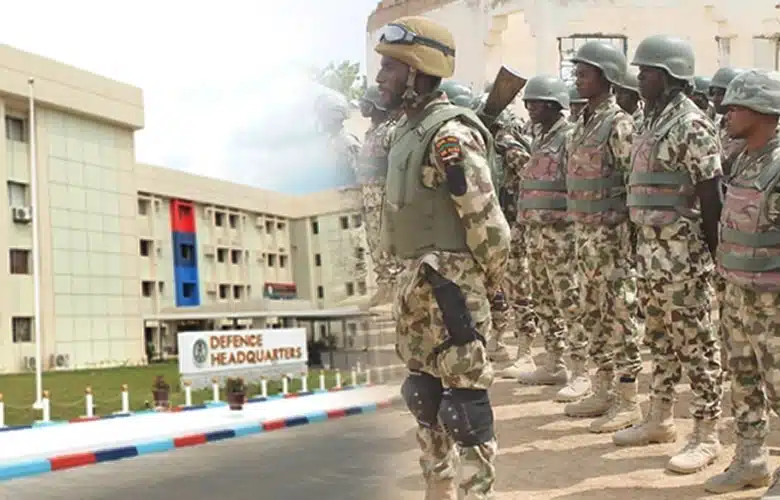
The Defence Headquarters (DHQ) has clarified that the reported withdrawal of about 200 United States military personnel from Nigeria does not amount to a collapse or termination of the security partnership between the two countries.
Naija News reports that the clarification was made on Tuesday by the Director of Defence Information, Major General Samaila Uba, during a security briefing organised by the National Counter Terrorism Centre.
Uba said the military had received several requests from journalists seeking clarification on reports concerning the planned withdrawal of American troops from Nigeria.
According to him, the presence of US personnel in Nigeria has always been linked to specific missions and operational objectives, meaning that adjustments to their deployment should not be viewed as an end to bilateral defence cooperation.
The New York Times had reported last week that the United States was planning to withdraw troops from Nigeria.
However, the report came after the commander of the United States Africa Command, General Dagvin Anderson, disclosed in July that “much of our forces” had already been withdrawn.
Anderson had also stressed that the adjustment would not end Washington’s cooperation with Abuja.
He said, “They are continuing the partnership that Nigeria has asked for to help continue with the intelligence sharing and the understanding that’s necessary.”
Reacting to the reports, Uba said the Nigerian military considered the troop reduction a mission-specific adjustment rather than a deterioration in relations between both countries.
He said, “The Armed Forces of Nigeria wishes to clarify that the reported withdrawal of about 200 United States personnel should not be interpreted as a breakdown or termination of the Nigeria-United States security partnership.”
He added that the defence relationship between Nigeria and the US remained strong, enduring, and mutually beneficial.
The Defence Headquarters spokesman explained that American military deployments were connected to particular counter-terrorism and operational assignments.
He said the changing nature of those missions could lead to adjustments in the number of foreign personnel stationed in the country without affecting the broader security relationship.
Uba stated that areas such as intelligence cooperation, military training, technical assistance and information sharing would remain central to the partnership.
“Our cooperation with the United States is designed to strengthen our capabilities through intelligence sharing, training, technical assistance and other forms of professional military cooperation,” he said.
He maintained that the primary responsibility for protecting Nigeria remained with the country’s security agencies, while international partnerships were designed to strengthen their capacity to deal with security threats.
According to him, the collaboration between Nigeria and the United States had continued to yield useful results in the fight against terrorism and other transnational crimes.
He added that both countries would continue working together in areas of mutual security interest.
Uba consequently appealed to the media and members of the public to avoid linking the troop drawdown to any perceived weakness in Nigeria’s defence capability.
“We equally call on the media and the Nigerian public to avoid interpreting a routine or mission-specific adjustment in foreign military presence as evidence of a collapse in Nigeria’s security cooperation or national defence capability,” he said.


The defence ministry have the last say