
Lawyers Fault Arrest Of ₦1.3 Billion Ghost Agency Suspect’s Father
 Follow on Google News
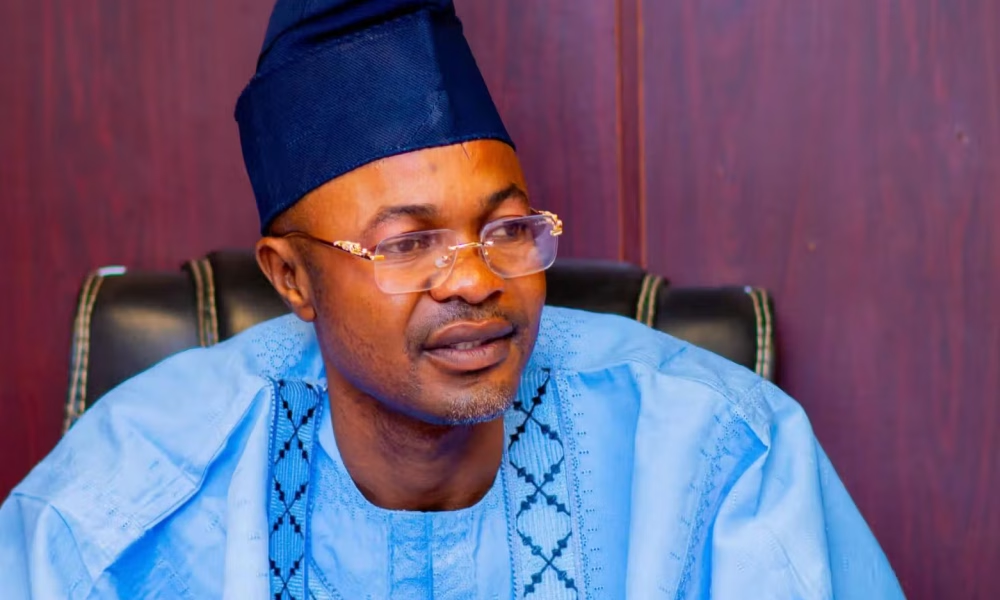
The arrest of Adeniyi Adeyemi’s father, the embattled promoter of the alleged ₦1.3bn Presidential Foreign Intervention Promotion Council (PFIPC), has sparked fresh legal and human rights concerns.
The President of the Nigerian Bar Association (NBA), Afam Osigwe (SAN), and other Senior Advocates of Nigeria (SAN) warned on Monday that Nigerian law does not permit the arrest of relatives to compel a suspect to surrender or assist investigators.
They, however, said the arrest would be lawful if Adeyemi’s father were himself a suspect or a person of interest in the ongoing investigation.
Osigwe, in a telephone interview with Punch, cautioned against rushing to conclusions, saying the circumstances of the arrest were still unclear.
“I’m careful about saying such things because I don’t know why his father was arrested,” Osigwe said.
He added, “If a person is arrested for the purpose of putting pressure on a suspect who cannot be found, or to compel a person who is being investigated to surrender, then it is unlawful.
“But if the person is being arrested in the person’s own right as a suspect or a person of interest in any investigation, then the law would permit that.”
The NBA president urged the public to seek clarification from the police rather than speculate.
“We don’t know the reason for the arrest. People may simply assume that because the son is involved in a criminal case, the father was arrested for that reason. We need to enquire from the police. It’s not too difficult,” he said.
SANs Condemn Arrest By Proxy
Another Senior Advocate of Nigeria, Professor Sam Erugo, said arresting a father over an offence allegedly committed by his son was unlawful.
“It is unlawful to arrest a father for an offence allegedly committed by the son,” Erugo said.
He noted that Section 7 of the Administration of Criminal Justice Act, 2015, expressly prohibits arrest by proxy or in lieu.
“The Nigerian public deserves more information from the arresting authority,” he added.
Similarly, Isiaka Olagunju (SAN) maintained that criminal responsibility is personal and cannot be transferred to relatives.
“It is unlawful to arrest a suspect’s father or relatives in a criminal case,” Olagunju said.
He, however, added, “Except if the father is also involved in the case, then the police can arrest.”
‘Arrest In Lieu Unconstitutional’
Wolemi Esan (SAN) described the practice of “arrest in lieu” as having no place in Nigeria’s legal system.
“Arrest in lieu has no place in Nigeria’s legal system,” Esan said.
He explained that Section 7 of the ACJA, 2015, and Section 20 of the Nigeria Police Act, 2020, prohibit the arrest or detention of any person as a substitute for a suspect.
“The Supreme Court has consistently denounced the practice as unconstitutional and a clear violation of the fundamental rights of those unlawfully arrested,” he added.
Esan also cited Section 35(6) of the 1999 Constitution, which guarantees redress for victims of unlawful arrest or detention.
“Any law enforcement agency that engages in arrest in lieu acts in defiance of both statutory and constitutional safeguards,” he said.
Shittu Cites Constitution, ACJA
Another Senior Advocate of Nigeria, Wahab Shittu, said the police could not lawfully arrest the father or any relative of a suspect merely to force the suspect to surrender or cooperate with investigators.
Shittu described such action as “substitutional arrest,” which he said is expressly prohibited under Nigerian law.
“The power of the Nigerian Police Force to arrest is neither unlimited nor unconditional,” he said.
He explained that Section 35(1) of the Constitution guarantees the right to personal liberty, while Section 36(8) provides that criminal liability is personal.
According to him, Section 7 of the ACJA, 2015, states that “a person shall not be arrested in place of a suspect.”
Shittu said the provision was introduced to end the practice of arresting parents, spouses or relatives to compel suspects to surrender.
“The gravity of an allegation, whether ordinary theft or alleged multi-billion-naira public fraud, does not alter the personal nature of criminal responsibility or expand the statutory and constitutional limits on the power of arrest,” he said.
Shittu noted that Adeyemi is already standing trial before the Federal High Court and is reportedly on bail, meaning he is not a fugitive from justice.
He said there was no public indication that Adeyemi’s father was independently suspected of forgery, impersonation or any related offence.
“If the true purpose of the operation was to pressure Adeyemi in connection with his pending prosecution or public allegations, that would amount to the very substitutional arrest prohibited by Section 7 of the ACJA and condemned by the courts,” he said.
He, however, added that the legal position would be different if the police could show independent evidence linking the father to the alleged offences.
“Should the police demonstrate that the father was arrested on the basis of an independent, particularised reasonable suspicion of his own complicity, the arrest would be assessed as an ordinary arrest of a suspect and not as a substitutional arrest,” he said.
Shittu urged the police to publicly disclose the legal basis for the arrest, stressing that “a bare family relationship is not a legal basis for arrest.”
The reactions followed reports that operatives of the Nigeria Police Force (NPF) arrested Adeyemi’s father at his residence on Plot 3, Adeniyi Dynasty, behind Technical College, Road Safety Area, Ogbomoso, Oyo State, on Monday.
The arrest was linked to the ongoing investigation into the alleged ₦1.3 billion “ghost agency” scandal involving the Presidential Foreign Intervention Promotion Council.
Author:


PFIPC: ‘Police Leave Adeyemi’s Mother In Shock After Father’s Arrest’

Arresting Father Of PFIPC ‘Fake DG’ Is Abuse Of Power – Atiku’s Aide

PFIPC: Stop Looking For Scapegoat – Atiku Clears Buhari, Blames Tinubu’s Govt

Senate To Address ₦1.3 Billion PFIPC Controversy Tomorrow

PFIPC Signage Still At Federal Secretariat Despite Presidency’s Denial
