
Sowunmi Weighs In On Bwala’s Interview Drama, Calls For Professional Media Training
 Follow on Google News

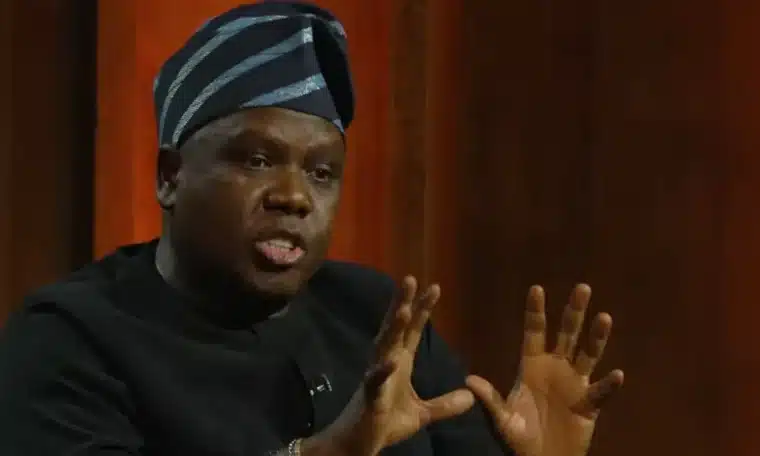
Former spokesperson to ex-Vice President Atiku Abubakar, Segun Sowunmi, has shared his thoughts on the controversy surrounding the interview of presidential aide, Daniel Bwala, with international journalist Mehdi Hasan.
Speaking in a commentary titled ”When Spokespersons Falter: Lessons in Strategic Communication. The Bwala/Mehdi meltdown,” Sowunmi called for an in-depth professional communication training to enable representatives to enhance their ability to convey messages effectively, manage crises, and promote transparency.
He argued that poor communication skills undermine the government’s image and credibility.
Sowunmi explained that by improving communication skills, government officials can better articulate policies, address public concerns, and foster a positive image.
He insisted that as a spokesperson, every word, tone, gesture, and response becomes part of the narrative that both domestic and foreign audiences use to evaluate a government.
He said, ”Recent interview performances by presidential representatives have reignited an important conversation about the professional standards required for spokespersons in the modern media environment. Confronting seasoned international interviewers such as Mehdi Hassan is not merely a media appearance; it is a high-stakes exercise in narrative management.
“Effective spokespersons are rarely accidental performers. Communication scholars often reference the “10,000-hour rule,” popularised by Malcolm Gladwell, to illustrate the level of sustained practice required to achieve mastery in complex professions. Professional spokespersons understand how to redirect hostile or loaded questions without appearing evasive.
“They rely on structured communication frameworks often summarised as a “4+1” approach: four supporting points anchored by one central message that consistently returns the conversation to the principal’s policy priorities.”
He maintained that discipline is a hallmark of professionalism, stating that communicators resist the temptation to speak for the applause of a narrow political audience.
“Equally important is situational awareness. Every media platform has a “house style,” every interviewer a known method of questioning, and every audience an expectation of tone. Preparation, therefore, involves understanding the adversarial dynamics of the interview environment, anticipating lines of attack, and crafting responses that maintain composure while advancing the government’s narrative.
“The craft also involves non-verbal communication. Tone of voice, pitch, cadence, posture, and controlled gestures are not cosmetic features; they are tools that reinforce credibility. Audiences often evaluate confidence and authority through these signals even before processing the substance of a response.
“For governments, the broader lesson is institutional rather than personal. Strategic communication should be treated as a professional discipline requiring training, mentorship, and continuous preparation. Many successful administrations invest heavily in communication war rooms, message simulation exercises, and spokesperson coaching to ensure that representatives are fully prepared for hostile interviews.
“In an era where a single media appearance can circulate globally within minutes, spokesperson performance is no longer a minor detail of governance. It is part of statecraft,” he added.

2027: Atiku Might Finish Distant Fourth In 2027, He Has No Backing – Bwala
Before Tinubu No One Could Travel From Abuja To Kaduna Without Security Agents – Presidency
Bwala Reveals Why Impact Of Tinubu’s Reform Is Slow

‘Babachir’s Words About Atiku Could Undermine National Security’ – Presidency

‘Peter Obi’s Followers Have Done Lot Of Manipulation’ – Presidency
