
US Withdraw Troops From Nigeria After ISIS Commander’s Killing
 Follow on Google News
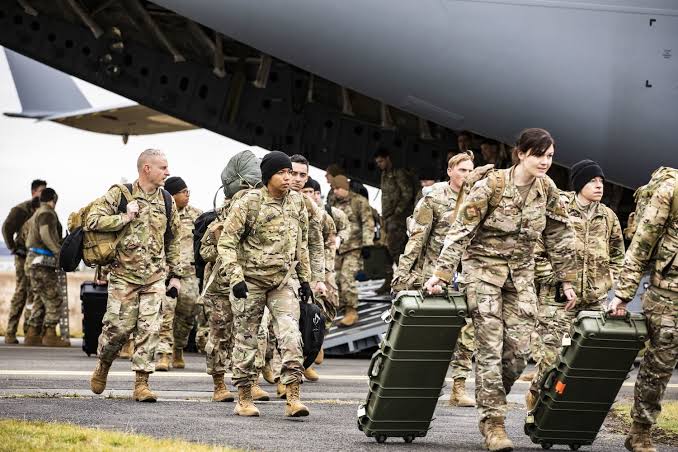
The United States (US) has withdrawn most of its troops deployed for a joint counterterrorism operation in Nigeria’s Lake Chad Basin.
The Commander of US Air Forces in Europe-Air Forces Africa, General Dagvin R.M. Anderson, disclosed this during a press briefing on the outcome of the African Chiefs of Defence Conference 2026.
The US had deployed about 200 military personnel to Nigeria in February to support intelligence, surveillance and counterterrorism operations in the Lake Chad Basin.
Anderson said the operation had ended, adding that most of the American personnel involved had left for Washington, D.C.
He, however, said the US would continue its security partnership with Nigeria, especially in intelligence sharing.
“And so that operation in the Lake Chad Basin of Nigeria not only helped the countries in that immediate region, but it also helps countries globally as that disrupts the ISIS network.
“And so, and then we have withdrawn much of our forces that were just there for that operation, but are continuing the partnership that Nigeria has asked for to help continue with the intelligence sharing and the understanding that’s necessary to be able to prosecute these difficult tasks,” he said.
US Hails Nigeria’s Military Capacity
The US general described Nigeria as a capable partner with a strong military, large economy and educated population.
He said intelligence cooperation between both countries had produced significant results in the fight against ISIS and other terrorist groups.
“I think the partnership that we’ve shown recently with Nigeria, where Nigeria’s a very capable and large country — it’s got a strong economy; it’s got a large, educated population; it’s got a very capable military,” Anderson said.
According to him, US counterterrorism experience helped strengthen Nigeria’s intelligence operations and contributed to the successful targeting of a senior ISIS figure.
“But there are things that we have learned in the counterterrorist fight over several years that we were able to assist and integrate with them to help them with their intelligence and help with the intelligence sharing that eventually led to a cooperative effort to where we were able to bring some unique capabilities that the U.S. brings and be able to prosecute together the number two leader within the ISIS or Daesh organization who is responsible for much of their global operations, their global media, and their recruiting,” he added.
ISIS Commander Killed
Naija News reports that the partnership between Nigeria and the US reportedly culminated in the killing of Abu-Bilal Al-Minuki, identified as the second-in-command of ISIS, at his hideout in Borno State.
Before then, the US had carried out airstrikes on two terrorist enclaves in the Bauni Forest in the Tangaza Local Government Area of Sokoto State on December 25, 2025.
The US deployment followed increased security cooperation between Washington and Abuja in the fight against ISIS and other terrorist groups in the region.
Anderson said the US model of support showed how Washington intended to work with African partners by providing unique capabilities that would help local forces become more effective.
“So I think as we go forward, that is an example of how we’re looking at engaging with partners to help them be more effective by only bringing unique U.S. capabilities that allow the partner to be effective in these fights,” he said.
He also called for stronger intelligence sharing among African countries to combat terrorism, illicit trafficking and other transnational crimes.
According to him, effective communication and established partnerships recently contributed to the interception of a record 31-ton cocaine shipment originating from South America and transiting along the West African coast.
“I was able to coordinate through our interagency in the United States, through AFRICOM, and then notify some of the partners. And eventually it was a Spanish ship that interdicted the ship that had 31 tons of cocaine on it, and it turns out is the largest interdiction of drugs at sea that we’ve ever seen,” Anderson said.
He added that sustained cooperation among African countries, international partners and the private sector would remain critical to tackling security threats and promoting economic stability and investment across the continent.
Author:

Gbajabiamila: ‘I Have Letter Of Appointment, But I Can’t Give You Details’ – Adeyemi
Fresh Document Links FG To ‘Non-existent’ Presidential Council With 300-job Approval

‘They Are After My Life, I’m Not Safe’ – Alleged Fake Presidential Council Boss Breaks Silence From Hiding

Court Rules On David Mark’s Position As ADC National Chairman

ICPC Gets Court Order To Detain Tinubu’s Former Minister