
Mass Abductions: Army Chief Seeks Practical Solutions From Military Strategists
 Follow on Google News

The Chief of Army Staff (COAS), Lt. Gen. Waidi Shaibu, on Thursday challenged military strategists to develop practical and innovative solutions to the growing menace of mass abductions across Nigeria, describing the security challenge as one of the country’s most pressing threats.
Naija News reports that the army chief gave the charge during the inauguration of the Army War College Nigeria Wargaming Centre in Abuja, where he urged the institution to leverage wargaming and strategic analysis to generate workable responses to kidnapping and other emerging security threats.
Shaibu noted that the increasing wave of mass abductions, particularly in rural communities and educational institutions, requires solutions that go beyond conventional military operations.
Speaking at the event, Shaibu said the Army War College must prioritise research aimed at tackling the country’s evolving security realities.
According to him, one of the major assignments before the institution is to determine how wargaming can be deployed to address recurring cases of mass kidnappings in Nigeria’s vast forested areas.
“One of the critical tasks I would like to leave with the college is how this wargaming can help address multiple mass abductions across our expansive forested areas.
“This is an evolving security challenge in Nigeria,” he said.
The COAS lamented that the persistent threat of kidnapping has continued to create fear among citizens, discouraging many parents from sending their children to school, especially in rural communities.
He stressed that the situation demands creative thinking, strategic planning and new approaches capable of complementing ongoing military operations.
Shaibu also urged the college to examine the likely implications of the proposed state policing structure on Nigeria’s security architecture.
He said military strategists should study how state police, if established, would affect operational coordination, command structures and emergency response mechanisms across the country.
The army chief further called for research on improving collaboration among the military, police and other security agencies to ensure faster responses to kidnapping incidents.
“When we talk about rapid response, we must consider the assets required and how decisions are made at the strategic level.
“Test those options and bring forward solutions,” he charged.
Shaibu expressed confidence in the Army War College’s ability to generate practical recommendations capable of strengthening Nigeria’s national security framework.
He described wargaming as an essential military planning tool that enables commanders and decision-makers to analyse complex operational problems, test multiple courses of action and anticipate possible reactions from adversaries before deploying troops.
According to him, the newly inaugurated Wargaming Centre will enhance military education, operational research, concept development, strategic planning and decision-making.
He urged the institution to transform the facility into a centre of excellence for operational and strategic wargaming, not only in Nigeria but across the African continent.
Earlier, the Commandant of the Army War College, Nigeria, Maj. Gen. Umar Alkali described the inauguration of the centre as a major milestone in the institution’s efforts to strengthen professional military education.
Alkali said the facility would help produce military leaders with enhanced critical thinking abilities, sound operational planning skills and the capacity to make effective decisions in increasingly complex security environments.
Also speaking, the Director of War and Strategy at the college, Brig.-Gen. Eyitayo Shoda said the Wargaming Centre was established to provide a structured environment where military planners could test ideas, challenge assumptions and evaluate different operational scenarios before implementation.
According to him, the college has already developed indigenous wargaming models tailored to Nigeria’s security realities.
He said the models cover counterterrorism, counterinsurgency operations, joint military operations and other national security scenarios, adding that they are expected to improve planning and strategic responses to emerging threats.
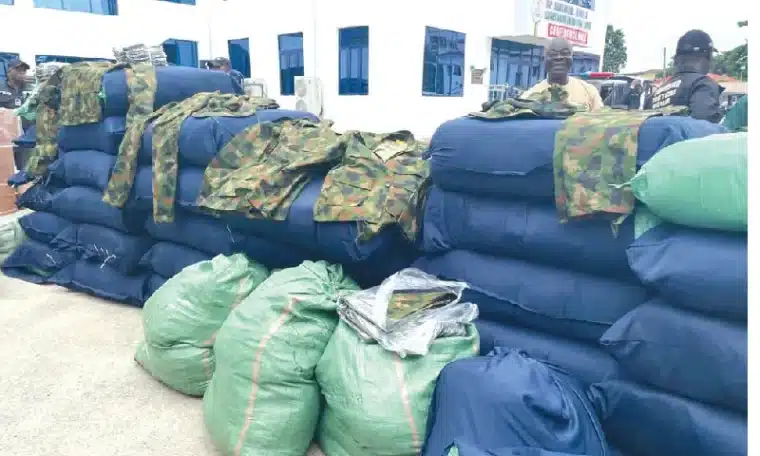
Police Intercepts 47 Sacks Of Military Uniforms, 80 Drug Cartons In Lagos

Defence Budget Not Reaching Armed Forces – SDP’s Adebayo Alleges
List Of Military Commanders Killed By Terrorists So Far In 2026

Army Chief Orders Troops To Step Up Operations Against Bandits, Kidnappers

DHQ Confirms Niger Airstrikes, Says 70 Bandits Killed In Shiroro
