
Kwara APC Crisis Deepens As Chieftain Defends Danladi’s Governorship Ticket
 Follow on Google News

The crisis rocking the Kwara State chapter of the All Progressives Congress has taken a fresh turn as a party chieftain and public affairs analyst, Musa Idris Buko, defended the emergence of the Speaker of the Kwara State House of Assembly, Salihu Yakubu-Danladi, as the party’s governorship candidate for the 2027 election.
Buko, who spoke on Arise Television’s The Morning Show, dismissed claims that the state had entered a “mourning period” following Danladi’s emergence, insisting that the outcome of the primary reflected a broader demand for political inclusion, fairness and justice.
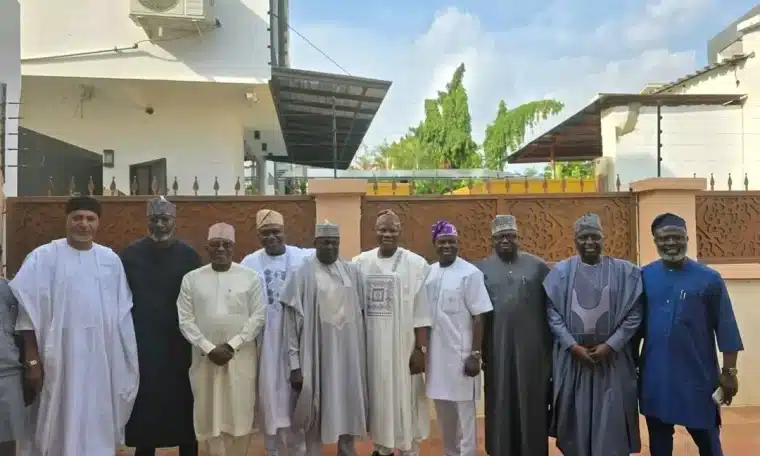
Naija News reports that Danladi’s emergence has divided elders and stakeholders within the Kwara APC, with one camp endorsing his candidacy and defending Governor AbdulRahman AbdulRazaq against allegations of imposition, while another caucus rejected the process as flawed and lacking legitimacy.
Last week, an APC chieftain in the state, AbdulMajid Abdullahi, appeared on the same programme, where he criticised the outcome of the primary and raised concerns over the internal process that produced Danladi.
‘Kwara North has been excluded’
Speaking during the interview, Buko said the agitation for Kwara North to produce the next governor was rooted in the political history of the state.
According to him, Kwara State, created in 1967, has three senatorial districts, Kwara Central, Kwara North and Kwara South, but Kwara North has remained largely excluded from the governorship seat.
He said, “Kwara Central senatorial district has had the seat of governorship for over 19 years now, to be completed 20 years in 2027, and Kwara South senatorial district has had the opportunity for eight years.
“Kwara North senatorial district, which constitutes the second largest demography of Kwara State, the largest landmass of Kwara State and the economic backbone of Kwara State, has not had the opportunity to be governor.”
Buko added that the district had only produced a governor for about 22 months before the administration was truncated by a military coup.
He maintained that the demand for power shift to Kwara North had gone beyond partisan politics, describing it as a “people’s movement” supported by political actors, traditional rulers, artisans and stakeholders across the state.
APC primary was democratic Buko
The APC chieftain said the primary, which he noted was held on May 22, produced a clear winner following what he described as a democratic process.
He said the backlash that followed the exercise could be traced to four categories of people.
According to him, the first group comprises supporters of the “One Kwara Project 2027,” who believe Kwara belongs to all its people and that political inclusion is necessary.
He described the second group as “sectional supremacists” who want one part of the state to continue controlling political power, while the third group, according to him, consists of “gerontocrats” who believe everything must align with their choices.
He added that the fourth group consists of those with a “rocking the boat mindset.”
Buko said, “If it is not me, then everything should go down the drain. The majority of Kwarans across the three senatorial districts are pleased and happy.”
He also commended President Bola Tinubu, the APC leadership and Governor AbdulRazaq for allowing what he called democratic inclusion for a “critically marginalised” part of the state.
“It is not true that Kwara has gone into mourning mode. The people that are mourning presently are the category of people I have told you about,” he said.
Aggrieved aspirants urged to accept party supremacy
Asked about the way forward amid the division, Buko urged aggrieved stakeholders to accept party supremacy and work for unity ahead of the 2027 election.
He said, “The way forward is to accept party supremacy, to know that the person that emerged, somebody must emerge. All of us cannot have a position.
“We have 35 elective positions in Kwara State and we have over 160 aspirants.”
He appealed to the President, the governor and the national leadership of the APC to intervene and reconcile aggrieved members, saying the party still needed everyone ahead of the election.
Buko added, “Kwara belongs to all of us and the outcome is in the interest of inclusiveness, strategic sustainable development of every nook and cranny of Kwara.
“It aligns with the principles of equity, fairness and justice.”
He further described Danladi’s emergence as a generational shift, noting that the Speaker is “barely over 41 years old.”
‘Danladi has grassroots appeal’
Responding to claims that Danladi lacks statewide appeal and that the primary amounted to imposition, Buko rejected the allegations.
He said petitions and complaints after elections were normal in politics, but maintained that the process that produced Danladi was democratic.
He said, “There is no time an election is conducted in this country without petitions at electoral tribunals. It is a normal process.
“I want to believe that these stakeholders have some demands. They want some recognition and they want to be recognised also. So I will urge the President and the governor of Kwara State to carry them along.”
Buko, however, accused some critics of attempting to destabilise the party because their preferred aspirant did not emerge.
He insisted that Danladi enjoys grassroots support and electoral value, adding that he had demonstrated political strength in previous elections.
He said, “The popularity, the electoral value and the grassroots rootedness of this candidate is unarguable. He is rooted, accessible and has learnt the rudiment of governance and politics in the past seven years.”
Insecurity requires joint action APC chieftain
The interview also turned to insecurity in Kwara State, with one of the presenters questioning why party leaders were speaking more about politics than about the security challenges facing the state.
Responding, Buko said insecurity in the state was influenced by several factors, including landmass, international borders, national parks and wider global security concerns.
He said, “There are a lot of factors. I can list up to 20 factors. We have the global conflict factor. We have the large landmass factor. We have the international border factor. We have national park factors.”
He said the federal and state governments were already making efforts to address the situation, but stressed that security matters required strategic handling and collective action.
According to him, “It requires the combined efforts of the federal government, the state government, the executive arms of government, the legislative arms of government, the judicial arms of government, the media and every responsible and patriotic citizen of Nigeria.”
Buko added that security issues were not always matters to be discussed openly in the same manner as politics.
“Security matters are very strategic. It is not something that you come out in public and be saying,” he said.
Kwara Lawmakers Endorse Speaker Danladi-Salihu For 2027 Governorship Race

Ten Kwara APC Governorship Aspirants Make Demand From Tinubu, Warn Gov AbdulRazaq

Terrorists Abduct OPC Member, Two Others During Ransom Delivery
Ten Kwara APC Aspirants Petition Tinubu, Accuse AbdulRazaq Of Losing Grip

Kwara Bans Graduation Ceremonies In Schools

