
Ayatollah Arafi Named Acting Iran Supreme Leader Amid Transition
 Follow on Google News
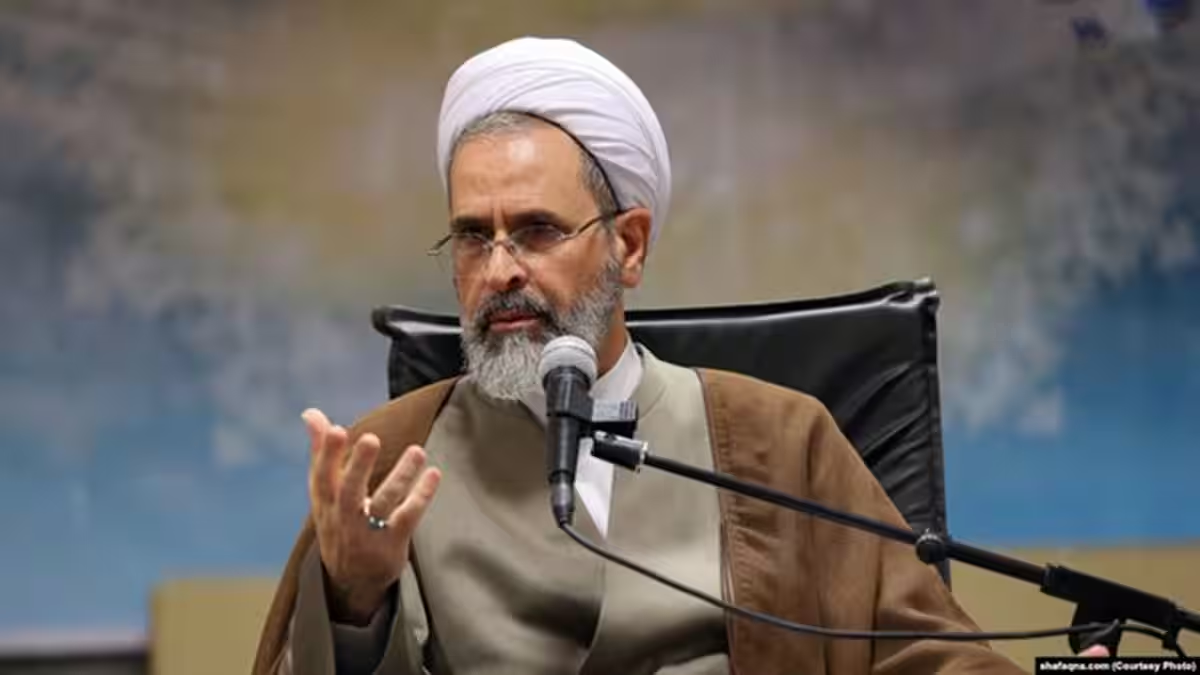
Ayatollah Alireza Arafi has been appointed as the acting Supreme Leader of Iran, according to the country’s official news agency, ISNA.
His emergence follows his election by Iran’s Expediency Discernment Council as the jurist member of the Guardian Council in the Leadership Council, a constitutional body tasked with temporarily discharging the duties of the Supreme Leader.
Naija News reports that the 67-year-old cleric, who currently serves on the powerful Guardian Council, was confirmed as part of the three-member Leadership Council by the Expediency Council.
The Leadership Council is mandated to carry out the responsibilities of the Supreme Leader pending the selection of a substantive successor by the Assembly of Experts, the body constitutionally empowered to make such an appointment.
The development marks a significant moment in Iran’s political landscape, as the Leadership Council steps in to ensure continuity at the highest level of governance.
Arafi will serve alongside President Masoud Pezeshkian and Chief Justice Gholamhossein Mohseni-Ejei on the Interim Council.
Under Iranian law, the three-member body is responsible for overseeing leadership responsibilities during the transition period, ensuring that the functions of the Supreme Leader’s office continue without interruption.
The arrangement is in line with constitutional provisions that outline the process to be followed in the event of a vacancy in the office of the Supreme Leader.
Until the Assembly of Experts concludes its deliberations and announces a successor, the Interim Council will remain in charge of key state matters, maintaining political stability and continuity in governance.
Arafi’s appointment is seen as reinforcing the institutional framework designed to manage leadership transitions in the Islamic Republic, while attention now shifts to the Assembly of Experts and its next move in determining Iran’s long-term leadership.
Naija News reports that the development comes hours after Israeli Prime Minister Benjamin Netanyahu announced there were indications that Iran’s Supreme Leader, Ali Khamenei, may no longer be alive following a joint United States–Israeli military operation targeting his compound.
Addressing reporters, Netanyahu said there were “signs” suggesting that Khamenei was “no longer alive,” though he did not provide evidence to substantiate the claim.
He also urged Iranian citizens to rise up, calling on them to “flood the streets and finish the job.”
Israel’s Channel 12 network reported that 30 bombs were dropped on the compound of the Iranian Supreme Leader during Saturday’s coordinated operation.
According to Channel 12 correspondent Amit Segal, who is regarded as close to the Israeli Prime Minister, the strike was extensive and specifically targeted the complex believed to house Khamenei.
“Thirty bombs were dropped on the complex. Ali Khamenei was underground, but probably not in his own bunker,” Segal said during the broadcast, without citing an official source.
There has been no independent confirmation of the report, and Iranian authorities have yet to issue a formal statement on the condition or whereabouts of the Supreme Leader.
Israel confirmed that Iran’s supreme leader was killed in strikes on Saturday, according to two Israeli sources familiar with the matter.

Iran Coach Ghalenoei Welcomes Eased Travel Rules Ahead Of Egypt Clash
Concerns As Iran Shuts Strait Of Hormuz Again, Suspends Nuclear Talks With US

Iran To File FIFA Complaint Over World Cup Travel Restrictions

‘These Fools Think I Was Not Tough Enough’ – Trump Attacks Critics On US-Iran Peace Deal

Nigeria, Africa Need Peaceful World Order – Olawepo-Hashim Hails US-Iran Peace Deal

