
Saraki Urges Africa To Rethink Donor Dependence After US Funding Retreat
 Follow on Google News

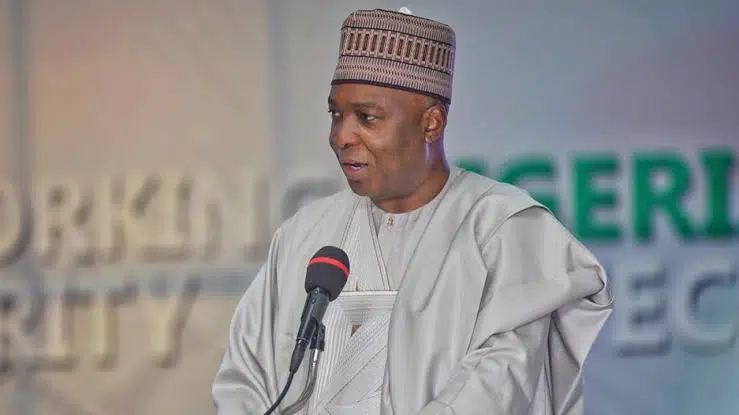
Former President of the Nigerian Senate, Bukola Saraki, has urged African nations to use the United States’ retreat from international development funding as an opportunity to overhaul the continent’s relationship with donor countries.
Naija News reports that Saraki made the call while speaking on a panel themed “Global Partnerships Without U.S. Leadership” at the Global Strategic Advisory Group (GSAG) meeting held at Villa La Collina, on the shores of Lake Como.
He warned that simply seeking to plug the funding gap left by Washington would be a missed opportunity.
“The challenge is not simply how to fill the gap left by a retreating United States,” he said, urging the continent instead to build a development architecture that is more sustainable and effective than the one it would replace.
Citing figures from UNAIDS and the African Development Bank, Saraki noted that up to 6.3 million additional HIV infections could occur over the next five years if funding gaps persist, while developing countries face an annual financing shortfall of between $15 billion and $18 billion as a direct result of the US aid cuts.
He said health supply chains had been disrupted, and civil society groups that anchored development delivery had lost support almost overnight.
Despite the scale of the disruption, the former Kwara State governor argued that Africa now holds greater strategic leverage than at any point since independence, citing growing interest in the continent from China, the Gulf states, India and Turkey.
He cited China’s Belt and Road Initiative, which he said has disbursed an estimated $94 billion in loans to African countries over the past two decades, as evidence of the widening field of potential partners.
Saraki outlined what he called three fundamental transitions Africa must make: moving from aid to genuine partnership, using development cooperation to strengthen institutions and governance, and investing in the next generation of political, economic and technological leaders.
On trade, he criticised the continent’s continued reliance on raw material exports, noting that Africa produces over 70 per cent of global cocoa but captures less than 5 per cent of the $130 billion global chocolate market, while Nigeria supplies about 40 per cent of the world’s raw shea nuts yet holds roughly 1 per cent of the global shea products market.
He also pointed to the gap between the price of exported bauxite and the price of imported aluminium as an example of value lost due to a lack of local processing.
The former Senate President was equally critical of weak domestic revenue generation across the continent, noting that Nigeria’s tax-to-GDP ratio stands at roughly 6 per cent, among the lowest in the world for an economy of its size, compared with a Sub-Saharan African average of about 15.6 per cent and an OECD average of 34 per cent.
He recalled his own experience in the Senate pushing for open budget hearings and scrutiny of unremitted government revenues, describing the resistance he faced at the time.
Turning to Europe, Saraki said he was not asking the bloc to simply replace USAID funding, but to support a “transformation model” built on trade, investment and long-term institutional partnership rather than short development project cycles.
He called for reform of EU-Africa trade frameworks, which he said currently allow African raw materials into European markets while keeping barriers on African manufactured goods.
He did not spare African governments either, urging them to accelerate domestic resource mobilisation, fully implement the African Continental Free Trade Area, and protect democratic institutions.
‘I Challenged The Executive On Foreign Loans Approvals’ – Saraki

Why EFCC Came After Me – Saraki

Some Lawmakers Never Raise Their Hands In The National Assembly, But Win Elections – Saraki
June 12 Might Happen Again In Nigeria – Saraki Warns
‘Another Diversionary Tactic’ – Saraki Reacts To Kwara Govt Defamation Charges Against Him
