
Naira Falls, NGX Loses ₦2.8 Trillion Stock As Trump’s Threat Rattle Investors
 Follow on Google News
The United States President, Donald Trump’s decision to classify Nigeria as a Country of Particular Concern (CPC) and his accompanying threat of possible military action have thrown the nation’s economy into turmoil for more than a week.
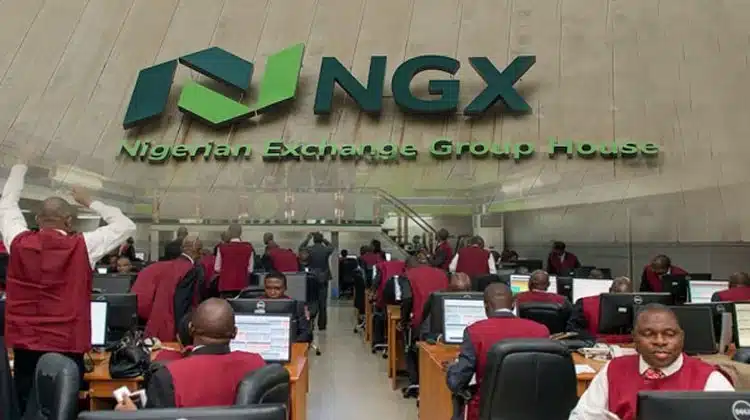
Financial experts have explained that since the announcement, both the Nigerian Exchange Limited (NGX) and the naira have recorded significant losses.
Naija News reports that the NGX, which had already shed ₦2.8tn last week, continued its downward slide on Monday, while the naira depreciated further to ₦1,437.29/$ at the official window and weakened across parallel market segments.
Economists say the developments point to shaken investor confidence and deep-seated anxiety about Nigeria’s global perception.
Former President of the Chartered Institute of Bankers of Nigeria, Mazi Okechukwu Unegbu, told Daily Post that the reaction was predictable because global investors respond instantly to political signals from major world powers.
According to him, Trump’s comments created an atmosphere of uncertainty, forcing investors to pause, delay or completely abandon investment plans.
Unegbu said the psychological effect was severe enough to trigger sell-offs on the NGX, capital flight and a sudden halt in new inflows. He explained that although the immediate panic cut across several sectors, he does not believe the U.S. president would actually carry out military action on Nigeria.
He added that the markets’ reaction exposed the fragility of Nigeria’s economic fundamentals.
The financial expert argued that previous gains recorded in the foreign exchange market were artificial because the country still relies heavily on imports.
He said the present downturn should encourage more strategic investments but insisted that meaningful recovery would only occur if Nigeria boosts its productive capacity.
Unegbu also stressed that insecurity continues to hamper agriculture and industrial output, both of which are essential for stabilising the naira.
‘Fear of sanctions and capital flight drove the plunge’ – Oyedokun
University lecturer and economist, Prof. Godwin Oyedokun, said the naira’s sharp depreciation and the ₦2.8tn equities crash reflect more than routine market volatility.
He said they indicate a deeper fear among foreign and domestic investors who view the CPC designation as a sign of strained diplomatic relations.
The Don explained that the global financial system is highly sensitive to political risk, adding that foreign investors tend to withdraw their funds quickly when a country appears to be entering conflict or facing sanctions.
According to Oyedokun, CPC designation is typically associated with concerns around governance, human rights or security. He said the label alone is enough to trigger market tension because investors immediately fear travel restrictions, reduced bilateral cooperation, financial sanctions or difficulties accessing international finance.
He noted that the sharp decline in the naira also shows that many Nigerians rushed to buy dollars in anticipation of further instability. He warned that such fear-driven behaviour worsens volatility and could keep the currency under pressure for weeks.
‘Avoid panic; Nigeria must respond strategically’
However, Oyedokun said what the nation needs now is composure rather than emotional financial decisions.
He warned that pulling out funds from the stock market, hoarding dollars or joining speculative buying would deepen the crisis.
The lecturer stressed that confidence is the backbone of all markets and that Nigeria must rebuild trust by showing a coherent response to the CPC designation.
He urged Nigerians to stay informed, remain rational and avoid social-media-driven misinformation that could push more people into panic decisions.
He added that while the immediate economic shock is severe, it also creates an opportunity for Nigeria to re-examine its governance practices, strengthen institutions and improve its international reputation.
Oyedokun said the federal government should urgently open diplomatic channels with the United States to clarify the circumstances surrounding Nigeria’s designation. He added that clear and transparent communication could ease investor fears and prevent further speculation.
He also emphasised the need for the Central Bank and fiscal authorities to work together to stabilise the financial system, protect the naira, and reassure both local and foreign investors through stronger policy signals.
Oyedokun noted that Nigeria must not ignore the underlying governance and security challenges that contributed to the current tension. According to him, strengthening the rule of law, improving human rights protection and tackling insecurity would help restore global confidence in the country.
The economist stressed that part of Nigeria’s vulnerability comes from its reliance on foreign markets and international perception. He said the country must build resilience by diversifying its economy, promoting local production, expanding regional trade and reducing dependence on external borrowing.
He explained that the situation, though unsettling, could push Nigeria to adopt long-delayed reforms that would eventually strengthen the economy.
Naija News reports that with the naira weakening, stocks crashing, and investors taking cautious positions, analysts say the coming days will be critical.
Market watchers warn that unless the government intervenes decisively through diplomacy and policy stabilisation, the turbulence could drag on longer than anticipated.
For now, Trump’s remarks have exposed Nigeria’s vulnerability to external shocks and highlighted the urgent need for structural reforms and improved international relations.

US Visa Applicants In Africa May Face Fresh Higher Travel Cost Under New Policy

Hegseth Reveals Secret Operation Ordered By Trump To Protect Nigerian Christians
Gunman Killed Near White House After Opening Fire

Why I Won’t Attend My Son’s Wedding – US President, Trump
Trump Orders Nigerians, Others To Process Green Cards From Home Countries

